Abstract
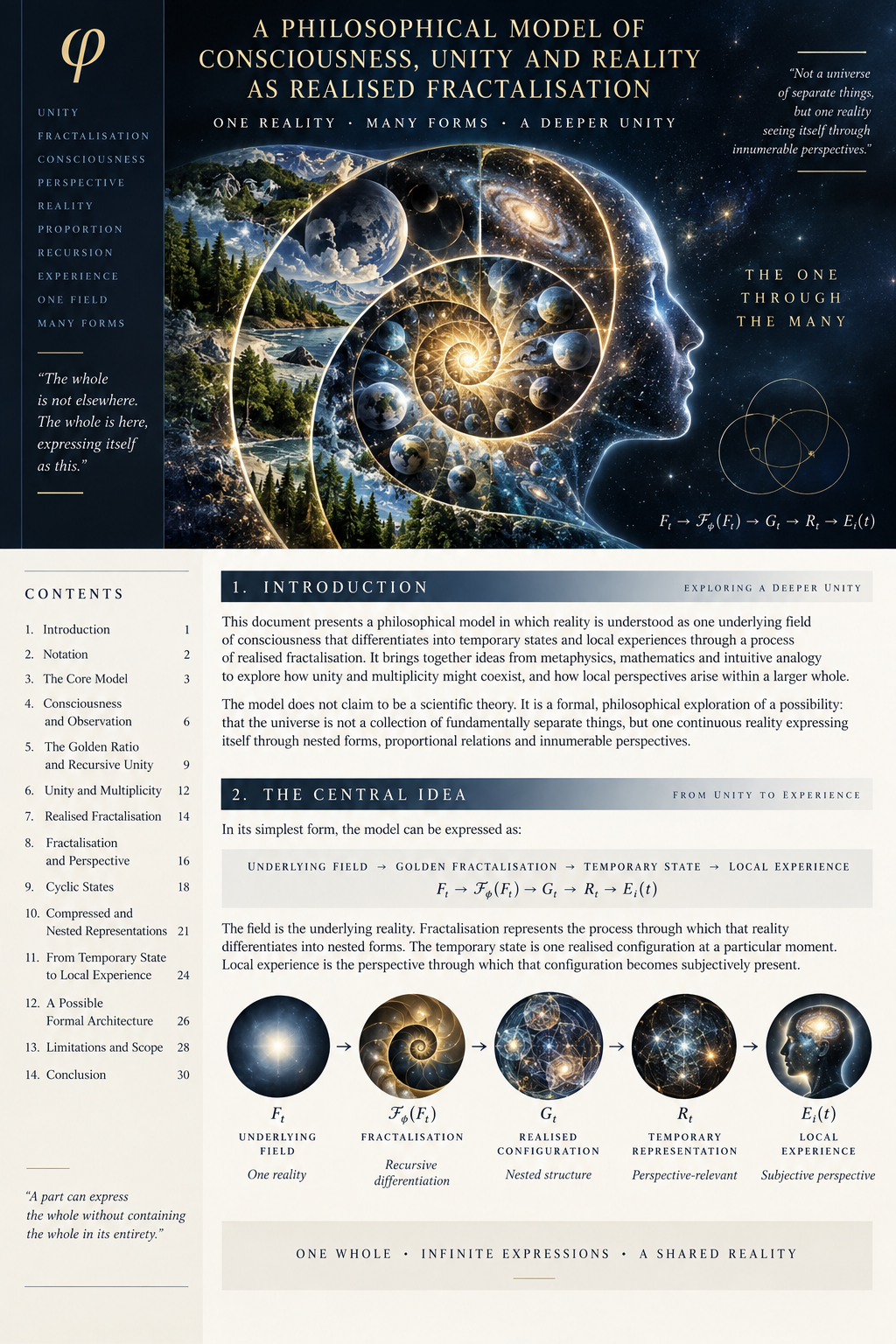
This thesis develops a metaphysical model in which reality is understood as one underlying field of consciousness that differentiates into temporary states, nested structures, unique centres of expression and local experiences. The model is holistic and non-dual without erasing individuality: distinction is treated as necessary for relation, while absolute separation is not assumed.
The ego is placed within this architecture as an interface of recognition rather than the ruler or source of consciousness. It gives a local perspective continuity, identity, memory, orientation and agency, allowing an observer to recognise self and other. In this sense, uniqueness and unity can coexist: a perspective can be genuinely distinct while remaining an expression within the same underlying field.
Mathematical structures - reciprocal invariance, the golden ratio, recursive relations, modular cycles and compressed state representations - are used as conceptual diagrams rather than as empirical proof. The thesis culminates in an ethic of participation expressed through Homo Ludens: the playing human who relates, creates and participates from within reality rather than imagining himself to stand outside or possess it.
Contents
- 1. Philosophical Orientation
- 2. Notation
- 3. The Core Model
- 4. The Ego as Interface of Recognition
- 5. Consciousness and Observation
- 6. The Rendering Analogy
- 7. The Golden Ratio and Recursive Unity
- 8. Unity and Multiplicity
- 9. Realised Fractalisation
- 10. Fractalisation, Individuation and Perspective
- 11. Cyclic States
- 12. Different Bases and Temporary State Representation
- 13. Compressed and Nested Representations
- 14. From Temporary State to Local Experience
- 15. Non-Duality and Relationship
- 16. Homo Ludens
- 17. A Possible Formal Architecture
- 18. Limitations and Scope
- 19. In Simplest Form
1. Philosophical Orientation
The model developed here is closest to what I describe as holistic non-dual panpsychism, with strong affinities to process philosophy and cosmopsychism. Its starting point is that reality is fundamentally one whole, while the distinctions within that whole are real and meaningful without necessarily amounting to absolute separation.
Non-duality does not mean that all differences disappear. Unity does not mean uniformity. Individuality does not require isolation. A person is a unique local expression of the same underlying reality that also expresses itself through other persons, organisms, matter, structures and processes.
The philosophical principle is distinction without absolute division. This distinction is essential because without difference there could be no relationship. If everything were completely indistinguishable, there would be nothing that could relate to anything else. But if everything were absolutely separated, relation would become equally impossible.
2. Notation
F the underlying field or whole of reality.
Fₜ the state of that field at time t.
𝓕φ a fractalisation operator representing recursive or nested differentiation, potentially involving proportional relations symbolised by φ.
Gₜ the realised geometric, relational, informational or experiential configuration produced at time t.
Rₜ a temporary representation or differentiation of Gₜ or Fₜ; it may be compressed or perspective-relevant without containing every detail of the total field.
Oᵢ observer i, understood as a temporary local configuration within the field.
Iᵢ the ego-interface of observer i: the local interface of recognition, identity, memory, distinction, orientation and agency.
Eᵢ(t) the local experience of observer i at time t.
Pᵢ the perspective through which observer i locally experiences relations within the field.
ℛᵢⱼ the relation between observers or states i and j within the same field.
φ the golden ratio, φ = (1 + √5) / 2 ≈ 1.6180339887…
3. The Core Model
The central idea is a metaphysical hypothesis: reality may be one underlying field of consciousness capable of differentiating into temporary states, local centres of experience and relations through a process of realised fractalisation.
By realised fractalisation, I mean that the underlying whole does not necessarily divide into fundamentally independent substances. Instead, it may unfold into nested configurations in which local states are genuinely differentiated while remaining expressions of the same underlying whole.
The model begins with monism. Observer, observed object, matter, space, biological life and subjective experience are not assumed to belong to fundamentally separate substances. They are configurations, relations or expressions within one underlying reality. This does not mean that observer and observed are identical; their distinction occurs within reality rather than dividing reality into disconnected domains.
The golden ratio enters not as a mystical substance or proof of cosmic design, but as a possible symbol of proportion, scaling and recursive relation. It is used to explore how a part can remain relationally connected to a whole across multiple levels of differentiation.
4. The Ego as Interface of Recognition
The ego occupies an important place within this model, but it is not regarded as the source, ruler or owner of consciousness. The ego is better understood as an interface of recognition: the local organisation through which a particular perspective can recognise itself, distinguish others, remember, orient, compare, choose and act.
- “I am here.”
- “That is there.”
- “This happened before.”
- “That is another person.”
- “This relates to me.”
- “I can act from here.”
The ego therefore provides local orientation and continuity. It enables identity, memory, distinction, decision and relationship. But its usefulness does not imply metaphysical dominance. The ego emerges within the field rather than creating the field.
The individual remains unique because no other observer occupies exactly the same biological structure, history, position, memory, attention, sensory perspective or relational context. Yet uniqueness occurs within what is fundamentally shared.
5. Consciousness and Observation
If I look at the Moon, I am not claiming that the Moon comes into existence because I look at it. The Moon already belongs to the underlying reality, and the observer also belongs to that reality. What becomes locally realised is the observer’s experience of the Moon: its colour, shape, apparent size, position, meaning and everything the sensory and cognitive organisation of the observer contributes.
Another observer can experience the Moon differently without requiring another underlying universe. Different perspectives do not necessarily imply different realities.
Within this philosophical model the deeper question becomes: what form does the underlying state have independently of one particular local experience, and what happens when that state enters into an observational relation with another configuration within the field?
The ego-interface contributes recognition: “This is the Moon,” “I am looking at it,” “I have seen this before,” or “It has meaning for me.” Subjective experience therefore does not have to be identical to objective reality, but neither does it have to exist outside objective reality. It is an event within it.
6. The Rendering Analogy
A rendering analogy can help clarify the distinction between an underlying reality and a local perspective. In a computer-generated environment, an underlying system state can support many possible viewpoints, while a player receives only the perspective available from a particular position.
This remains an analogy. It does not imply that reality literally runs on a graphics engine, that the universe is a computer simulation, that consciousness literally performs DLSS, or that objects cease to exist when unobserved. The comparison illustrates only that a complete underlying description is not identical to a locally experienced view.
- The underlying field corresponds conceptually to the total system.
- Fractalisation corresponds to nested organisation.
- Rₜ corresponds to a currently relevant state representation.
- Oᵢ corresponds to a local position within that structure.
- Iᵢ corresponds loosely to the interface through which local recognition and orientation occur.
- Eᵢ(t) corresponds to the resulting local experience.
7. The Golden Ratio and Recursive Unity
The golden ratio satisfies φ² = φ + 1, 1/φ = φ − 1, and φ = 1 + 1/φ. If a whole is divided into a larger part a and a smaller part b, the golden-ratio relation is a/b = (a+b)/a = φ.
This provides a mathematical example in which the relation between part and part resembles the relation between whole and part. Within the model, φ therefore serves as a possible symbol of recursive proportionality. It is not presented as proof that consciousness or the universe is physically generated by φ.
Repeated powers of φ can be expressed recursively:
The integer coefficients follow the Fibonacci sequence. The Fibonacci recurrence Fₙ₊₁ = Fₙ + Fₙ₋₁ has the limiting ratio limₙ→∞ Fₙ₊₁/Fₙ = φ. This is a useful image of a simple local rule generating larger structures while tending toward a stable proportion.
8. Unity and Multiplicity
The underlying whole may remain one while differentiating internally. A simple mathematical analogy is reciprocal invariance:
The scale changes and the factors change, while the reciprocal relation remains 1. Philosophically, I use this as an analogy for differentiation within Unity. It illustrates the intuition; it does not prove the metaphysics.
- Multiplicity does not necessarily imply separation.
- Unity does not necessarily imply uniformity.
- Fractalisation does not necessarily imply fragmentation.
- Individuation does not necessarily imply isolation.
- Non-duality does not mean absence of difference.
9. Realised Fractalisation
The term fractal is commonly associated with visual patterns displaying self-similarity across scales. I use realised fractalisation more broadly. It refers to the possibility that an underlying whole becomes expressed through nested, recursive or relational levels of differentiation.
The resulting structure could be spatial, temporal, informational, relational, experiential, geometric, biological or mathematical. The important point is that the realised state is not necessarily an isolated finished object; it is the present expression of an unfolding process.
The field is therefore conceived not merely as a warehouse of completed objects but as an ongoing capacity for differentiation and relation. “Realised” does not mean created from absolute nothingness; it means becoming expressed as a particular temporary configuration.
10. Fractalisation, Individuation and Perspective
An observer occupies a particular local organisation within the larger field. This can be represented as:
This does not mean that Oᵢ is imprisoned inside an absolutely isolated bubble. It means that the whole is encountered from a particular local organisation. Human experience is shaped by bodily scale, sensory systems, neural organisation, memory, language, attention, emotion, needs, history, social relations and physical location.
These conditions contribute to individuation. The ego-interface helps organise them into a recognisable perspective:
The self-other boundary is therefore functional and perspectival without necessarily being metaphysically absolute. It has enough stability for identity and relationship without being imagined as an impenetrable ontological wall.
11. Cyclic States
Modular arithmetic provides another mathematical analogy for temporary states existing within a stable relational structure. For example, powers of 2 modulo 9 produce:
Mathematically this is simply periodicity within modular arithmetic. It does not demonstrate that consciousness or the universe literally operates according to powers of 2 modulo 9. I use it as an image of changing states existing within a stable relational structure.
A modular cycle emphasises recurrence; golden-ratio recursion emphasises proportional unfolding; fractalisation emphasises nested differentiation. I sometimes call a cyclic or recursively organised state a vortex state. This is my own philosophical term rather than established physics terminology.
12. Different Bases and Temporary State Representation
Nothing in the modular example makes base 10 or modulo 9 metaphysically privileged. For positional numeral systems, the familiar digit-sum relationship generalises through the modulus b − 1.
- base 10 → mod 9
- base 12 → mod 11
- base 24 → mod 23
The important idea is therefore not a particular “magic number.” It is the possibility of describing a complex process through compact temporary states. A digital root does not preserve all information contained in the original number; it preserves a particular residue class. Likewise, within this philosophical analogy, a temporary state representation may simply indicate where the process is now.
13. Compressed and Nested Representations
Here C represents a mapping from a larger realised configuration into a temporary representation. The word compressed is conceptual. It does not imply that the universe literally stores compressed files or necessarily performs a digital encoding operation.
The point is that a smaller state description may represent a particular aspect of a much larger process. Thus the present representation may contribute to the next state without being identical to the complete field.
A clock is a simple analogy: its current position represents where it is now without displaying every previous revolution. Similarly, the current state can be treated as a conceptual record of the conditions relevant for subsequent states.
Nested and temporal descriptions need not conflict. A process may be expansive in time while nested in structure.
14. From Temporary State to Local Experience
This equation is a conceptual schema, not a tested psychological or neuroscientific law. It indicates that experience depends, within the model, on the field’s state, its realised configuration, its temporary representation, the local observer and the ego-interface through which recognition occurs.
If another observer participates, that observer can have a different local experience while both remain within one underlying reality:
The relation between observers can itself become part of later experience. Encounter changes us; relation becomes part of the conditions of subsequent experience.
15. Non-Duality and Relationship
Non-duality is sometimes misunderstood as the claim that there are no differences. That is not what I mean. If there were no meaningful difference between self and other, there would be no meeting, recognition, dialogue, love, play or relationship.
The existence of relationship therefore requires differentiation. But differentiation does not logically require absolute separation. The model can be expressed as same in ground, different in expression; one in being, many in perspective.
The first statement concerns differentiation; the second concerns participation in a common whole. The individual is therefore neither dissolved into featureless unity nor isolated into absolute independence. The individual is a relational centre of expression.
16. Homo Ludens
This philosophical view also connects to how I want to live. I use the term Homo Ludens - the playing human - not merely to mean entertainment or childish play. Play, in the deeper sense, is participation.
A player enters into relation with other players, rules, possibilities, uncertainty, imagination, creativity, risk, movement and surprise. A player is neither completely dissolved into the game nor completely outside it. The player participates.
If the ego is an interface rather than an absolute ruler, identity does not have to be defended as a fortress; it can become a point of participation. If others are genuinely distinct but not fundamentally alien, relation becomes more important than domination. If reality is process rather than possession, creativity becomes more meaningful than rigid control.
The goal is therefore not destruction of the ego. It is putting the ego in its proper place. The ego recognises the player, distinguishes other players, remembers the game and makes decisions, but it does not have to imagine that it owns the playing field.
17. A Possible Formal Architecture
18. Limitations and Scope
This model is a metaphysical and philosophical hypothesis. It is not presented as an experimentally established physical theory. The equations are formal diagrams of relationships within the model.
- The inclusion of the golden ratio does not prove that the universe is universally organised according to φ.
- The use of modular cycles does not prove that consciousness follows modular arithmetic.
- The term fractalisation does not prove that physical reality is literally a mathematical fractal.
- The rendering analogy does not prove that reality is a simulation.
- The ego-interface concept does not deny the biological and neurological mechanisms involved in identity, memory and perception.
The model can fully acknowledge that brain states, sensory systems, memory, attention, emotion and embodiment profoundly influence experience. Its philosophical question lies one level deeper: are those biological mechanisms independently existing generators of consciousness, or local configurations through which a more fundamental reality becomes locally experienced? That remains a metaphysical question.
The hypothesis is not “human consciousness creates reality” and it is not “the individual ego is God.” It is closer to the following set of propositions:
- Reality is one underlying whole.
- Consciousness is fundamental to that whole.
- The whole differentiates into temporary configurations.
- Individuals are unique local expressions of those configurations.
- The ego is the interface through which a local expression recognises itself and others.
- The ego is functional, but not metaphysically dominant.
- Distinct observers can relate because they are different.
- They can relate meaningfully because their difference occurs within a shared reality.
- Subjective experience is locally realised within that larger whole.
- Fractal, modular and proportional mathematics provide abstract languages for exploring these relations, not empirical proof of them.
19. In Simplest Form
REALISED FRACTALISATION
↓
MANY TEMPORARY STATES
↓
MANY UNIQUE POINTS OF EXPRESSION
↓
EGO AS INTERFACE OF RECOGNITION
↓
RELATION
↓
MANY LOCAL PERSPECTIVES
↓
PARTICIPATION
↓
HOMO LUDENS
All of these remain within one underlying Unity. The field remains. The structure differentiates. The state changes. The individual becomes recognisable. The ego provides an interface. The other remains genuinely other. Relationship becomes possible. Perspective remains local. Participation becomes meaningful. The whole expresses itself through its parts without being exhausted by any one of them.
— END OF THESIS —